AC Light Dimmer Module 8A, 1 Channel, 3.3V/5V logic
DZD 3,500
Description
Description
The AC Light Dimmer module allows you to control alternating voltage loads (220V AC) from a microcontroller such as Arduino/Pic/Raspberry Pi/ESP8266.
An AC Dimmer (unlike a Relay) allows regulated control of AC voltage, allowing to obtain RMS intermediate voltages between 0 and 220V AC and
thus vary the brightness intensity of incandescent bulbs, the speed of AC motors such as fans, the power of a resistive heater and more.
The device integrates optocouplers for electrical isolation between the control stage and the power stage.
The Dimmer module can also be used as a Solid State Relay or SSR for ON/OFF control of AC loads.
- A dimmer integrates two stages: the zero crossing detector and the triac.
- The zero crossing detector is a circuit (usually an optocoupler) that allows to identify the instant in which the alternating voltage has a value of 0V,
- that is to say when the voltage "crosses" from positive to negative voltage and vice versa.
- Triacs are semiconductor devices (thyristors) that can allow the passage of AC current through a trigger signal in every half cycle of AC current.
- The triacs are the heart of the Solid State Relay or SSR.
- Unlike traditional mechanical relays, a triac can be activated very quickly, allowing a portion of the alternating voltage wave to pass through.
- To regulate the AC voltage, the dimmer needs to synchronizethe zero crossing with the microcontroller and from that moment decide the moment of activation of the Triac,
- in this way it is possible to regulate which part of the sine wave will be active and in this way regulate the amount of energy to deliver. This technique is known as
- shooting angle control and is the most recommended to vary the brightness of light bulbs without causing flickering. At the programming level in Arduino, the use of external Interruption and Timmer is required.
- Another control method using this device is Pulse Jump Modulation (PPM).
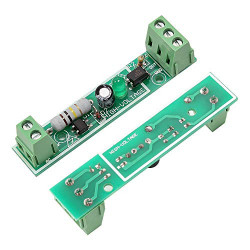
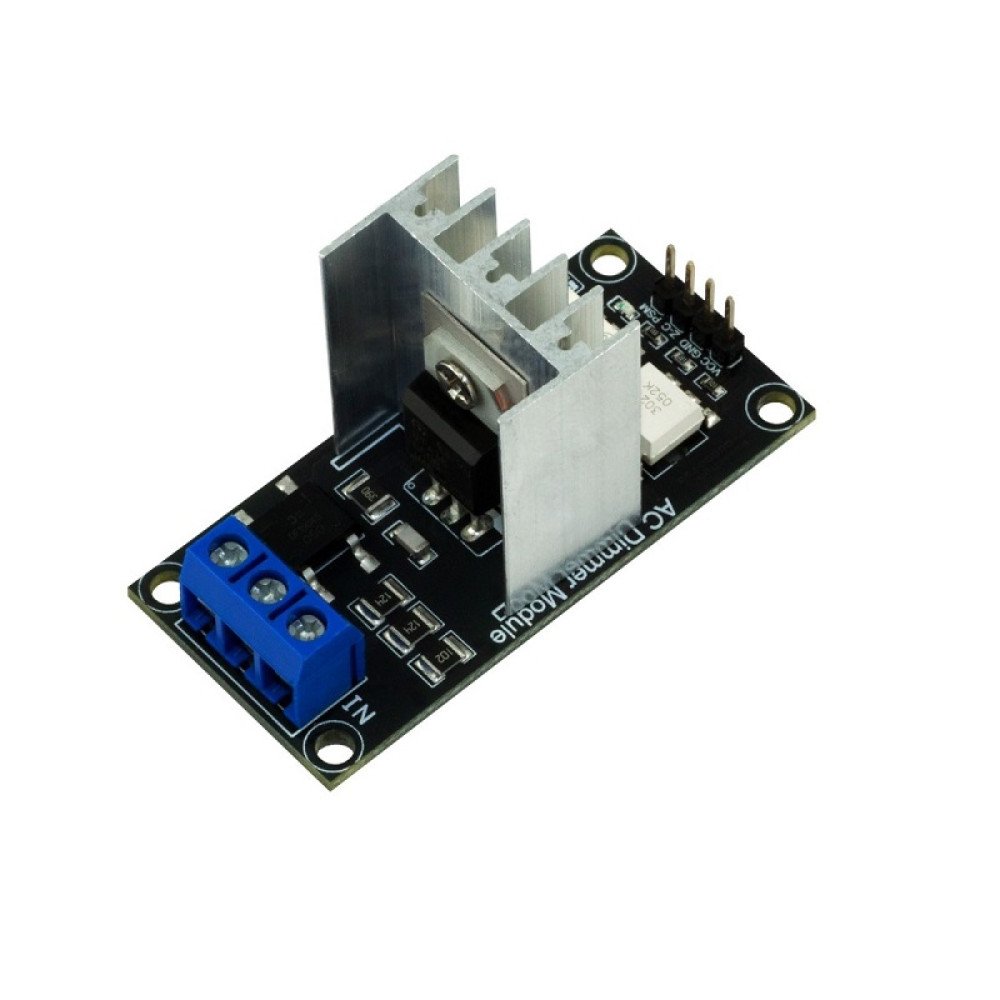
- The module connection is divided into two groups: power and control. In the power part there are three pads; the AC supply voltage must be placed to the N (Neutral) and IN (Line) terminals, the load to the OUT (Line) terminal and to close the circuit the load must be connected to Neutral. In the control part there are 4 male pins, "VCC" must be connected to 5V DC, "GND" connects to 0V (GND), "ZC" is the zero-cross pin and must be connected to a digital input of the Arduino with support for external interruption (Pin 2 or 3 on Arduino Uno), "PSM" is the trigger control pin of the triac (trigger) and must be connected to a digital output of the Arduino.
NOTE: CERTAIN PARTS OF THIS MODULE WILL BE CONNECTED TO 220VAC, THE VOLTAGE OF 220V AC IS VERY DANGEROUS! IMPROPER HANDLING OF AC VOLTAGE CAN CAUSE DEATH!
CREATELABZ IS NOT RESPONSIBLE FOR DAMAGE CAUSED BY THE MISUSE OF THIS MODULE.
Specification:
- Brand Name: RobotDyn
- Condition: New
- Type: AC light dimmer
- Control Voltage: 3.3-5V DC
- Charging Voltage: 110/220V AC (max.)
- AC frequency: 50/60 Hz
- Rated load current: 4A
- Maximum charging current: 8A
- Load power: 1000W max.
- Triac: BTA16 – 600B
- Optical isolation with: MOC3021 and PC817
- Dimensions: 54*28*25mm
- Weight: 20 grams
CONNECTION
- IN: Power line L
- N: Power line N
- OUT: Output to the load, switch IN (Line L)