Voir sur le site du vendeurLes prix et la disponibilité sont mis à jour quotidiennement. Veuillez vérifier sur le site du vendeur avant d'acheter.
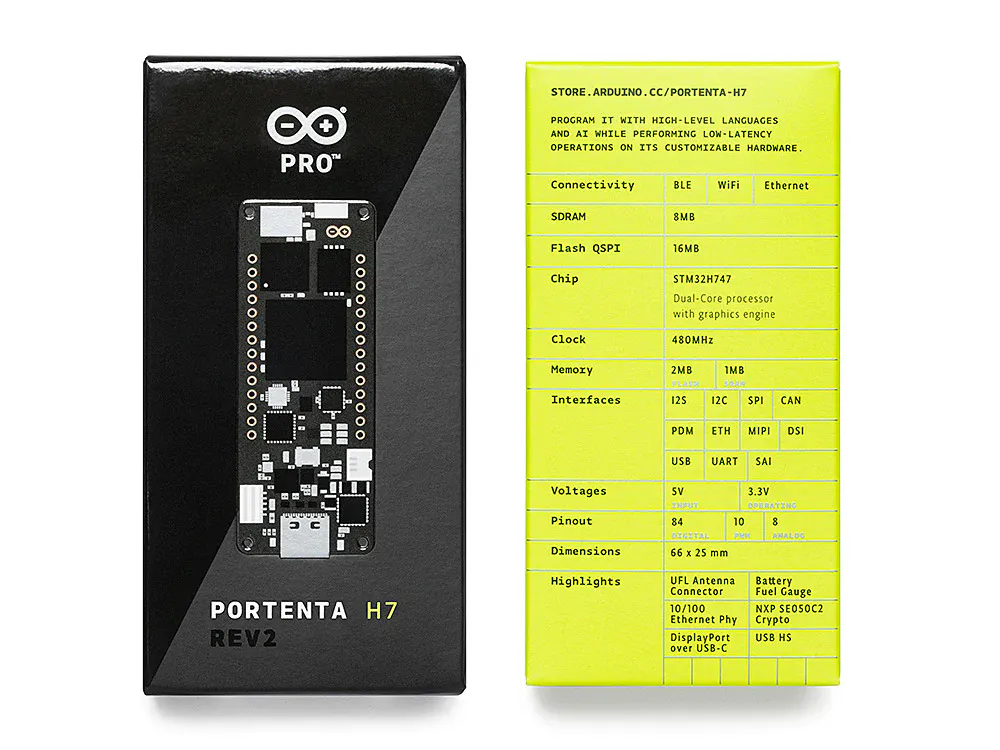
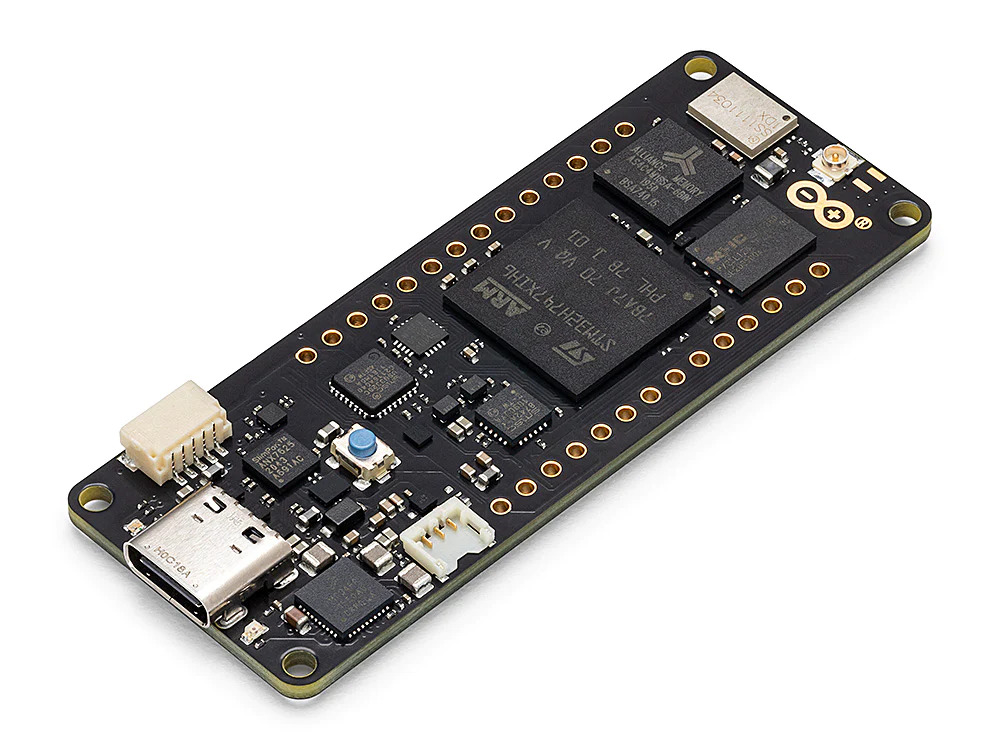
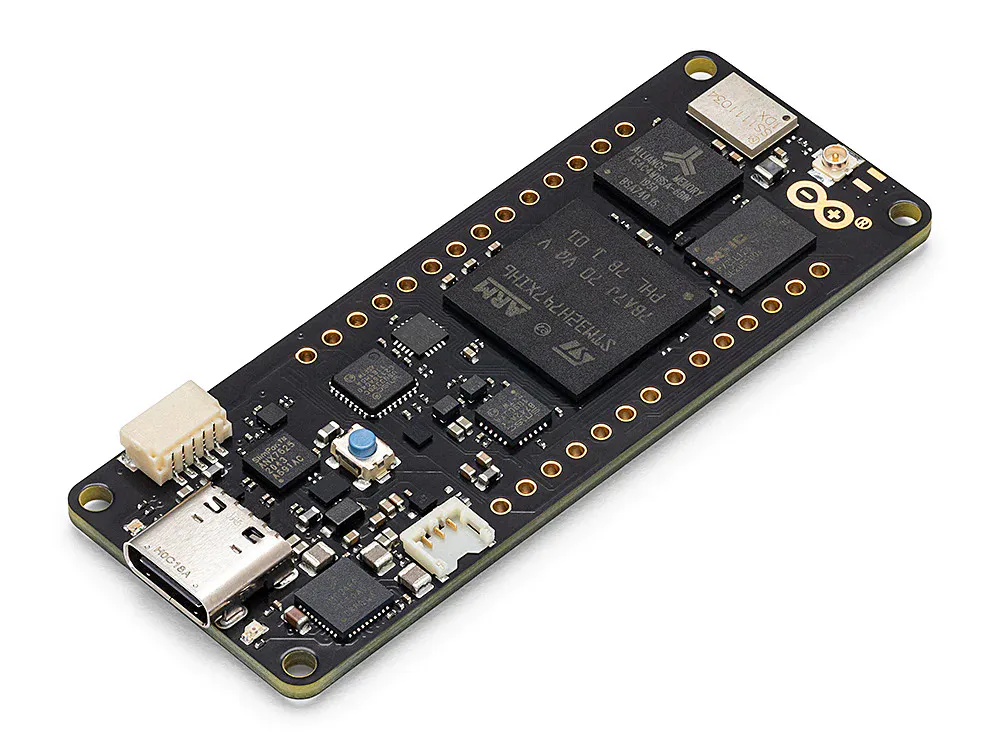
Arduino Board Portenta H7
DZD 35 000
Voir sur le site du vendeurLes prix et la disponibilité sont mis à jour quotidiennement. Veuillez vérifier sur le site du vendeur avant d'acheter.
Description
Overview
Portenta H7 allows you to build your next smart project. Ever wanted an automated house? Or a smart garden? Well, now it’s easy with the Arduino IoT Cloud compatible boards. It means: you can connect devices, visualize data, control and share your projects from anywhere in the world. Whether you’re a beginner or a pro, we have a wide range of plans to make sure you get the features you need.
Portenta H7 simultaneously runs high level code along with real time tasks. The design includes two processors that can run tasks in parallel. For example, is possible to execute Arduino compiled code along with MicroPython one, and have both cores to communicate with one another. The Portenta functionality is two-fold, it can either be running like any other embedded microcontroller board, or as the main processor of an embedded computer.
Portenta can easily run processes created with TensorFlow™ Lite, you could have one of the cores computing a computer vision algorithm on the fly, while the other could be making low-level operations like controlling a motor, or acting as a user interface.
Use Portenta when performance is key, among other cases, we envision it to be part of:
High-end industrial machinery
Laboratory equipment
Computer vision
PLCs
Industry-ready user interfaces
Robotics controller
Mission-critical devices
Dedicated stationary computer
High-speed booting computation (ms)
Two Parallel Cores
H7's main processor is the dual core STM32H747 including a Cortex® M7 running at 480 MHz and a Cortex® M4 running at 240 MHz. The two cores communicate via a Remote Procedure Call mechanism that allows calling functions on the other processor seamlessly. Both processors share all the in-chip peripherals and can run:
Arduino sketches on top of the Arm® Mbed™ OS
Native Mbed™ applications
MicroPython / JavaScript via an interpreter
TensorFlow™ Lite
Graphics Accelerator
Probably one of the most exciting features of the Portenta H7 is the possibility of connecting an external monitor to build your own dedicated embedded computer with a user interface. This is possible thanks to the STM32H747 processor's on-chip GPU, the Chrom-ART Accelerator™. Besides the GPU, the chip includes a dedicated JPEG encoder and decoder.
A new standard for pinouts
The Portenta family adds two 80 pin high density connectors at the bottom of the board. This ensures scalability for a wide range of applications by simply upgrading your Portenta board to the one suiting your needs.
On-board Connectivity
The onboard wireless module allows to simultaneously manage WiFi and Bluetooth® connectivity. The WiFi interface can be operated as an Access Point, as a Station or as a dual mode simultaneous AP/STA and can handle up to 65 Mbps transfer rate. Bluetooth® interface supports Bluetooth Classic and Bluetooth® Low Energy. It is also possible to expose a series of different wired interfaces like UART, SPI, or I2C, both through some of the MKR styled connectors, or through the new Arduino industrial 80 pin connector pair. The 80-pin connector pair provides additional features including Ethernet.
USB-C® Multipurpose Connector
The board's programming connector is a USB-C port that can also be used to power the board, as a USB Hub, to connect a DisplayPort monitor, or to deliver power to OTG connected devices.
Multiple options in one board
Order the default Arduino Portenta H7 (codename H7-15EUNWAD) that comes with:
STM32H747 dual-core processor with graphics engine
8MB SDRAM
16MB NOR Flash
10/100 Ethernet Phy
USB HS
NXP SE050C2 Crypto
WiFi/BT Module
External Antenna
DisplayPort over USB-C
Tech specs
The Arduino Portenta H7 is based on the STM32H747 microcontroller, XI series.
Microcontroller
STM32H747XI dual Cortex®-M7+M4 32bit low power Arm® MCU (datasheet)
Radio module
Murata 1DX dual WiFi 802.11b/g/n 65 Mbps and Bluetooth® (Bluetooth® Low Energy. 5 via Cordio stack, Bluetooth® Low Energy 4.2 via Arduino Stack) (datasheet)
Secure Element (default)
NXP SE0502 (datasheet)
Board Power Supply (USB/VIN)
5V
Supported Battery
Li-Po Single Cell, 3.7V, 700mAh Minimum (integrated charger)
Circuit Operating Voltage
3.3V
Display Connector
MIPI DSI host & MIPI D-PHY to interface with low-pin count large display
GPU
Chrom-ART graphical hardware Accelerator™
Timers
22x timers and watchdogs
UART
4x ports (2 with flow control)
Ethernet PHY
10 / 100 Mbps (through expansion port only)
SD Card
Interface for SD Card connector (through expansion port only)
Operational Temperature
-40 °C to +85 °C
MKR Headers
Use any of the existing industrial MKR shields on it
High-density Connectors
Two 80 pin connectors will expose all of the board's peripherals to other devices
Camera Interface
8-bit, up to 80 MHz
ADC
3× ADCs with 16-bit max. resolution (up to 36 channels, up to 3.6 MSPS)
DAC
2× 12-bit DAC (1 MHz) available, only one is accessible by the user through the external A6 pin
USB-C
Host / Device, DisplayPort out, High / Full Speed, Power delivery
Conformities
The following Declarations of Conformities have ben granted for this board:
REACH
For any further information about our certifications please visit docs.arduino.cc/certifications
Documentation
Study how the Portenta H7 board works using the following files:
SCHEMATICS IN .PDF DATASHEET IN .PDF
Pinout Diagram
The Portenta H7 follows the Arduino MKR form factor, but enhanced with the Portenta family 80 pin high-density connector. Learn more about the board's pinout by reading the board's pinout documentation.
Download the full pinout diagram as PDF here.