Voir sur le site du vendeurLes prix et la disponibilité sont mis à jour quotidiennement. Veuillez vérifier sur le site du vendeur avant d'acheter.
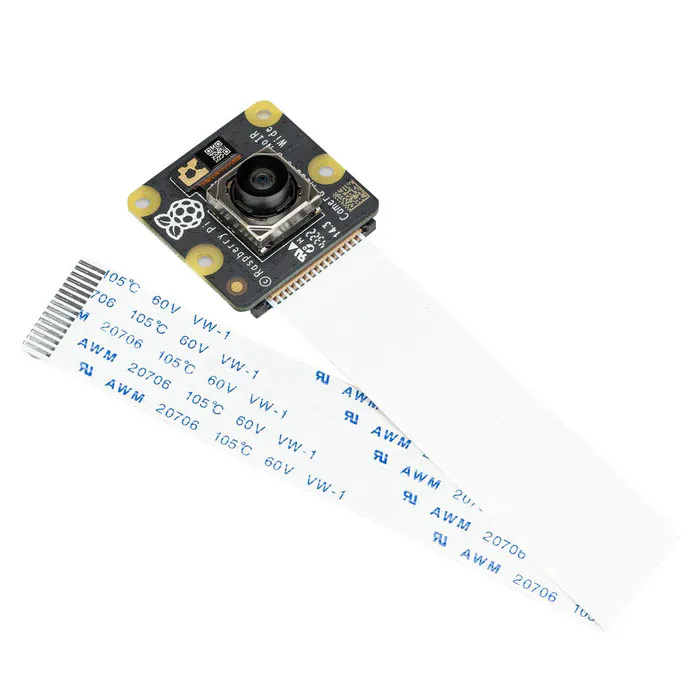
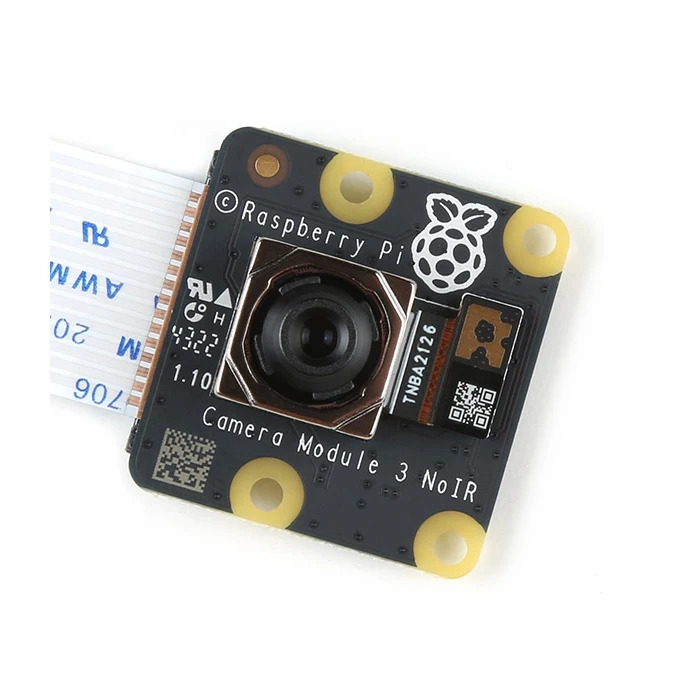
IR camera module v3 Raspberry Pi wide angle (120°)
DZD 17 000
Voir sur le site du vendeurLes prix et la disponibilité sont mis à jour quotidiennement. Veuillez vérifier sur le site du vendeur avant d'acheter.
Description
Description :
The v3 camera module offers some nice improvements over its predecessor:
improved low-light sensitivity: ideal for capturing shots in low-light conditions,
Supports HDR mode to capture detailed and realistic photos and videos,
Improved autofocus.
Features
Sony IMX708 image sensor with built-in IR filter
11.9MP native resolution
Motorized autofocus
Phase Detection Focusing (PDAF) for fast focusing
Angle: wide angle (120°)
7.4mm sensor diagonal
Pixel size: 1.4μm × 1.4μm
Photo resolution: 4608 × 2592 pixels
Video modes: 1080p50, 720p100, 480p120
Output: RAW10
HDR mode up to 3 megapixels
High signal to noise ratio (SNR)
Built-in 2D Dynamic Pixel Correction (DPC)
I2C controlled focus sensor
Compatible with all Raspberry Pi models except Raspberry Pi 400 and the 2016 launch version of the Zero, which do not have a camera connector)
Zero models require a camera cable Raspberry Pi Zero
The Raspberry Pi 5 model requires a specific ribbon cable
Connect via the supplied ribbon cable to the CSI port on your board Raspberry Pi
Recommended configuration: libcamera-still from 06/01/2023 on Pi OS 32 bits Buster (desktop version to update)
Python Picamera2 library compatible Raspberry Pi
Dimensions standard version: 25 × 24 × 11.5mm
Dimensions wide angle version: 25 × 24 × 12.4mm
Weight: 4.3g
Standard version
Wide angle version
Focusing range
10cm-∞
5cm-∞
Focal length
4.74mm
2.75mm
Diagonal field of view
75°
120°
Horizontal field of view
66°
102°
Vertical field of view
41°
67°
Focal ratio
F1.8
F2.2
IR filter
Built-in
Integrated
Discover the Camera Module v3 Raspberry Pi
HDR
HDR stands for "High Dynamic Range" and refers to a technology that consists of reproducing an image faithful to what the human eye perceives.
To fully understand HDR, it is necessary to look at the dynamics of the human eye vs.
the dynamics of the photo sensor. Most modern sensors manage to achieve a dynamic range of about fifteen stops.
As for the eye, it reaches a dynamic range between 20 to 24 stops.
Therefore, a camera is unable to accurately reproduce the contrasting scene that you perceive.
The camera will offer you an image with underexposed shadows or overexposed lights.
HDR mode provides a solution: instead of taking a single picture, HDR captures a series of images of the same scene at different exposures.
This series is then stitched together into a single photo in which each light tone is better exposed.
Dynamic range is intended to capture maximum detail in both very bright and very dark areas, giving richer colors and higher contrast.
The very bright and the very dark parts of an image will be better rendered for a more natural result and close to reality!
Useful Resources
Blog Raspberry Pi: Model comparisons
Download
Camera module v3 data sheet
Download (1.17MB)
Camera module v3 dimensions 75
Download (412.56KB)
Camera module v3 dimensions 120
Download (387.01KB)